What Is Ductless Heating and How Does It Work?
Ductless heating is changing how many homes manage winter comfort. Instead of forcing warm air through large ducts, a heat pump moves heat between outdoor and indoor units. A compact outdoor compressor connects to wall-mounted or ceiling-mounted indoor heads. Each head delivers conditioned air directly into a room.
The U.S. Department of Energy reports that air-source heat pumps can reduce electricity use for heating by about 50% compared with electric resistance systems. The International Energy Agency also identifies heat pumps as a major tool for lowering building emissions and improving energy efficiency. These figures matter, but they are not promises for every house. Climate, insulation, sizing, and installation quality can alter real-world results.
Jan Rosenow, an energy-efficiency expert and director of European programmes at the Regulatory Assistance Project, has said, “Heat pumps are the most efficient way of heating buildings.” Ductless heating applies that principle in a practical way. In heating mode, the outdoor coil extracts low-temperature heat from the air. Refrigerant carries that energy indoors, where the system releases it through a quiet fan.
It feels almost counterintuitive.
The process still requires electricity. Poor placement can create cold corners, while neglected filters can restrict airflow and reduce comfort. The U.S. ENERGY STAR program therefore emphasizes professional sizing, correct commissioning, and regular maintenance. This guide examines the equipment, refrigerant cycle, controls, operating costs, and limitations behind ductless heating. It also questions a common assumption: efficient equipment cannot compensate for a poorly insulated room or careless installation.
What Is Ductless Heating?
What Is Ductless Heating?
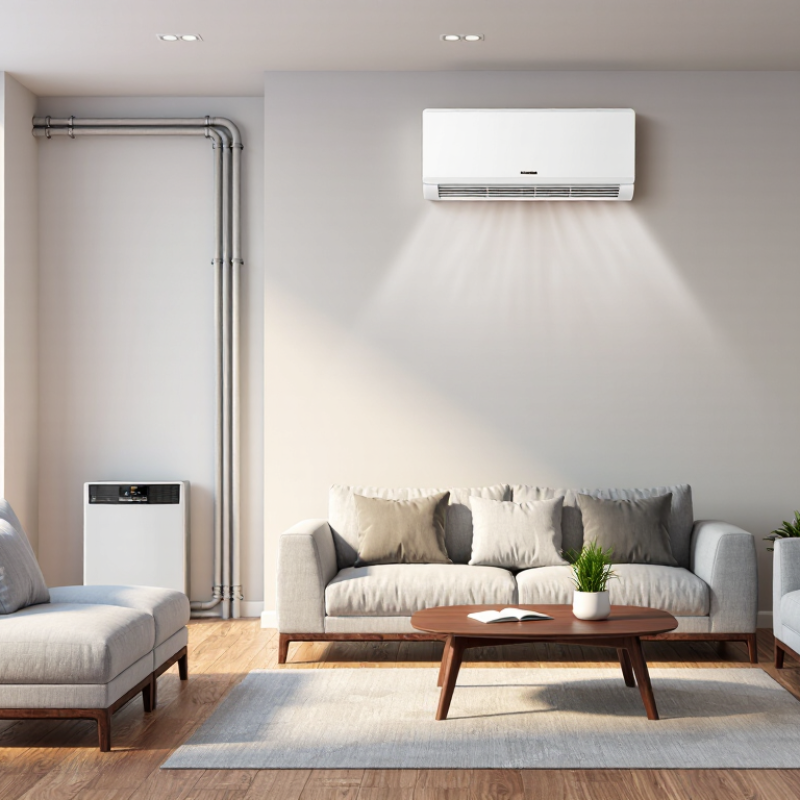
Ductless heating uses a heat pump to warm rooms without traditional air ducts. A compact outdoor unit moves heat from outside air into the home. Even during cold weather, outdoor air contains usable heat. Refrigerant carries that energy indoors through narrow lines. Wall-mounted or ceiling-mounted air handlers then distribute warm air directly into living spaces. Each indoor unit can serve one room or a connected zone. This design reduces hidden ductwork and supports room-by-room temperature control.
The U.S. Department of Energy reports that heat pumps can deliver two to four times more heating energy than the electricity they consume. ENERGY STAR also states that certified ductless systems may use up to 60% less energy than standard electric resistance heating. These figures depend on climate, insulation, equipment sizing, and installation quality. The technology is efficient, but it is not effortless. Poor placement can create warm ceilings and cold corners. Incorrect sizing may cause frequent cycling or uneven comfort. Filters still need regular cleaning, especially in homes with pets or dusty floors. In my view, the outdoor unit’s defrost cycles deserve more attention. They can briefly interrupt heating, and some homeowners mistake this behavior for a fault. A professional assessment remains valuable before installation.
| Data Dimension | Key Point | How It Works or What It Means | Practical Consideration |
|---|---|---|---|
| Definition | Heating without air ducts | Ductless heating uses an outdoor heat-pump unit connected to one or more indoor air-handling units. Heat is delivered directly into rooms instead of traveling through a central duct network. | It is useful for homes without existing ductwork, room additions, converted spaces, and buildings where installing ducts would be difficult. |
| Primary Heat Source | Outdoor air | In heating mode, the system extracts available heat from outdoor air and transfers it indoors through a refrigeration cycle. | The system can still collect heat in cold weather, although heating capacity and efficiency generally decrease as outdoor temperatures fall. |
| Main Components | Outdoor unit, indoor unit, refrigerant lines, and controls | The outdoor unit contains the compressor and heat-exchange equipment. The indoor unit distributes warm air, while insulated refrigerant lines connect the two units. | A small wall, floor, or ceiling penetration is normally required for the line set, condensate tubing, and electrical connections. |
| Heat Transfer Process | Refrigerant-based heat exchange | The refrigerant absorbs heat outdoors, is compressed to raise its temperature, and releases heat through the indoor coil. The cycle reverses when the system provides cooling. | The same equipment can usually provide both heating and cooling, depending on the operating mode and model design. |
| Air Distribution | Direct room-by-room delivery | Indoor units use fans to circulate conditioned air directly within the rooms where they are installed. | Good indoor-unit placement is important because air may not move evenly through closed doors, hallways, or multiple floors. |
| System Configurations | Single-zone and multi-zone | A single-zone system connects one outdoor unit to one indoor unit. A multi-zone system connects one outdoor unit to several indoor units. | Multi-zone systems allow different rooms to have separate temperature settings, but total capacity must be correctly matched to the building. |
| Energy Efficiency | Measured with heating-efficiency ratings | Seasonal heating performance is commonly represented by HSPF2, while electrical consumption is also influenced by outdoor temperature, controls, insulation, and operating habits. | Compare the current efficiency ratings shown on the equipment’s energy label. A higher rating does not guarantee lower bills in every building or climate. |
| Duct-Related Losses | No central duct leakage or duct heat loss | Because conditioned air does not pass through a duct network, the system avoids energy losses associated with poorly sealed or uninsulated ducts. | Overall performance can still be reduced by incorrect sizing, restricted airflow, dirty filters, poor insulation, or unsuitable installation. |
| Cold-Weather Operation | Performance varies with outdoor temperature | Cold-climate heat-pump models are designed to maintain operation at lower temperatures, but their capacity and efficiency depend on the specific equipment and conditions. | In colder regions, a properly designed supplemental heat source may be needed for peak heating demand or backup operation. |
| Temperature Control | Individual zone control | Each indoor unit can often be controlled separately using a remote control, wired controller, timer, or compatible smart control. | Zoning can reduce heating in unused rooms, but comfort depends on correct sensor location and maintaining reasonable airflow between spaces. |
| Installation Time | Usually less invasive than installing new ducts | Installation generally involves mounting the indoor and outdoor units, connecting the refrigerant lines, completing electrical work, and testing the system. | Project duration varies with the number of zones, wall access, electrical requirements, local regulations, and weather conditions. |
| Indoor Comfort | Steady, low-speed heating | Many ductless heat pumps use variable-speed compressors that adjust output to match the heating load instead of switching fully on and off repeatedly. | Longer, lower-output operating cycles can provide more consistent temperatures, but airflow and sound levels vary by model and fan setting. |
| Maintenance | Regular filter and coil care | Indoor filters should be inspected and cleaned according to the operating environment. Outdoor coils must remain free of leaves, dirt, snow, and other obstructions. | Professional inspection may be appropriate for refrigerant checks, electrical components, drainage, airflow, and overall system performance. |
| Noise | Generally quiet indoor operation | Indoor sound mainly comes from the fan, while the compressor and outdoor fan operate outside the occupied space. | Actual sound levels depend on fan speed, installation quality, mounting surfaces, outdoor-unit placement, and the selected equipment. |
| Best Applications | Existing homes, additions, and individual rooms | Ductless systems are well suited to spaces that lack ducts or require independent temperature control. | A heat-loss calculation and room-by-room assessment should be completed before selecting capacity or the number of indoor units. |
| Limitations | Visible indoor units and limited air mixing | Most systems require an indoor unit in each conditioned zone, and direct air delivery may not distribute heat evenly through a large or compartmentalized floor plan. | Alternative indoor-unit styles, transfer grilles, supplemental equipment, or a different heating design may be appropriate in some layouts. |
Related Posts
-
Top Benefits of Ductless Heat and Air Systems in 2025
-
What Are the Top China Ductless HVAC System Manufacturers?
-
How to Choose the Best Ductless HVAC System?
-
China Top 10 Ductless Heat and Air Manufacturers?
-
Discover How Ductless Heat and Air Systems Revolutionize Home Comfort and Efficiency
-
The Ultimate Guide to Ductless Heating Solutions for 2025